Tag: Circular Economy

  • From Waste to Wealth: Navigating Nigeria’s Circular Food Frontier
    Host: Dr. Sama A, Guest: Iyanuoluwa Faith Abimbola | The Sustainability Side, Episode 10 Recap

    Every year, Nigeria generates over 32 million tons of solid waste. Nearly half of that is food waste, yet less than 10% is currently recycled. That is more than just a statistic; it is a staggering amount of “wasted potential” ending up in landfills and waterways.

    But what if we stopped seeing waste as a problem and started seeing it as a resource? On this episode of The Sustainability Side, we dive into the Circular Shift, a movement to re-imagine Nigerian food systems to reduce waste, regenerate ecosystems, and build a resilient future.

    We were joined by Iyanuoluwa Faith Abimbola, a fisheries scientist and sustainability enthusiast whose work bridges the gap between aquaculture health and eco friendly innovation.

    1. The Cultural Shift: It’s Not New, It’s Nigerian

    While “Circular Economy” sounds like a high-tech global trend, Faith points out that its principles have been part of the Nigerian daily life for generations.

    • The Traditional Roots: From handing down clothes to younger siblings to repurposing old fabrics as rags, the concept of a “total life cycle” is already built into our culture.
    • The Convenience Trap: The rise of plastic sachet water was born from a need for convenience. However, before the sachet, Nigerians relied on refillable pots and pails, a naturally circular system.
    • The Opportunity: Shifting back to sustainability doesn’t mean “dehydrating the poor”; it means businesses must innovate and ideate around refill stations and biodegradable alternatives that thrive in our climate.

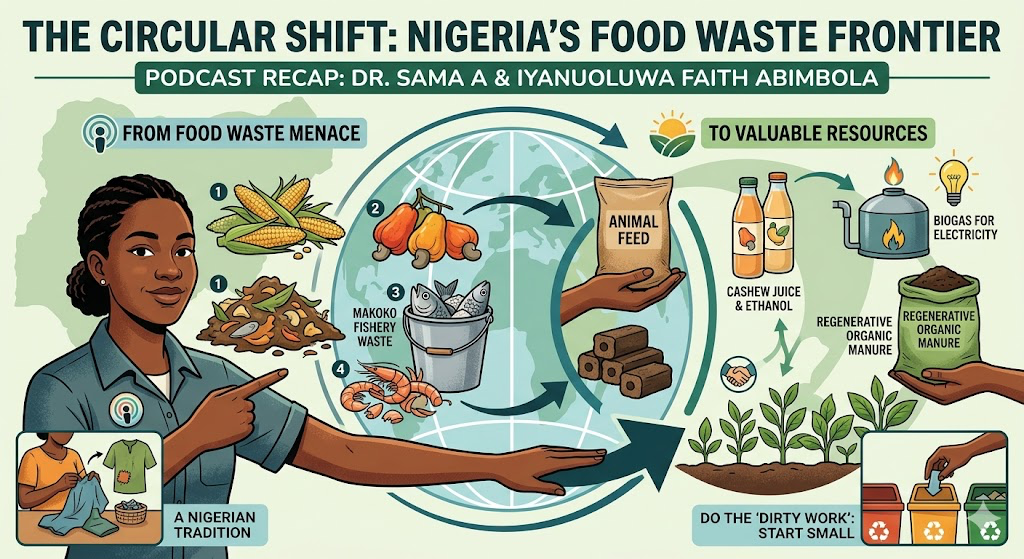
    2. The 4 Untapped “Gold Mines” in Food Waste

    Where others see trash, Faith sees a commercial treasure trove. She highlighted four specific waste streams that are currently undervalued in Nigeria:

    • Corn Cobs: Often discarded, these can be processed into animal feed or used to create fuel briquettes for energy.
    • Cashew Apples: While the nuts are exported, the apples are often left to rot, releasing methane. They can be transformed into juices or ethanol.
    • Fishery Waste: Fish scales and heads from markets like Makoko are perfect feed-stock for biogas plants to generate electricity.
    • Shrimp Shells: Rich in chitosan, these shells are a premium source for soil conditioners and regenerative organic manure.

    3. The Investor’s Reality Check: Do the “Dirty Work”

    If you are an aspiring eco-entrepreneur, Faith’s advice is grounded in the hard reality of the Nigerian market. Green investors aren’t just chasing elegant ideas; they are backing execution.

    • Access Over Apps: Investors care less about a fancy SAS platform and more about feed-stock access. If you can prove you have a signed agreement to collect 1,000 tons of waste, you are investable.
    • The “Dirty Job” Model: The real money is made in the downstream—the physical collection and processing. Technology should be a tool to make this “dirty work” seamless, not a replacement for it.
    • Unit Economics: A model that works profitably for 10 tons a week is far more attractive to a funder than a grand “scale-up” plan that hasn’t moved a single bag of waste yet.

    4. Your Action Plan: Starting with Zero Capital

    You don’t need a massive grant to join the circular movement. Faith suggests looking at the waste systems already in your backyard:

    • Identify the Stream: Visit local markets (like the grain or fish markets) where waste is currently a “menace” to the sellers. They will often give you the waste for free just to clear the space.
    • Focus on the “Small Win”: Start by collecting specific waste for existing biogas plants or organic farmers.
    • The Mindset Breakthrough: Stop waiting for the government to “do business.” The government’s role is to create an enabling environment; the individual’s role is to provide the value and the solution.

    Conclusion: Reimagining Sustainability as a Culture

    Sustainability in Nigeria isn’t just about protecting the planet; it’s about building smarter, more resilient communities. By turning our “waste” into “wealth,” we move toward a future where circularity isn’t just a choice—it’s our culture.

    Every step toward circularity, no matter how small, helps build a better way forward. As Faith prepares for her PhD journey in ocean management, her message remains: Sustainability is not just mine, it’s ours.

    Ready to dive deeper into the future of circular food systems? Support The Sustainability Side on PatreonKo-fi, or join our Discord community to access exclusive bonus content and connect with fellow change-makers.

    • Check out the episode on YouTube: Click here to watch
    • Connect with Iyanuoluwa Faith Abimbola: Follow her journey as she explores the intersections of fisheries, climate resilience, and circular food systems.

  • Social Media & Climate Change: Tool or Trap? Turning Screen Time into Circular Action
    Host: Dr. Sama A, Guest: Edwin Siuda | The Sustainability Side, Episode 8 Recap

    Every day, the world spends countless hours scrolling, with over 4.6 billion people using social media. That’s nearly 60% of the global population. But imagine what happens when we shift our digital habits.

    Suddenly, that massive amount of screen time becomes an opportunity for global change. Instead of falling into the trap of negativity and wasted time, vulnerable communities and younger generations can turn awareness into tangible action.

    In this episode of The Sustainability Side, we tackle a powerful question: How can two powerful forces—education and social media—rewrite the stories of climate action?

    We were joined by Edwin Siuda, co-founder of Numanity and a passionate voice for accessible environmental education. His work bridges the gap between digital immersion and community-driven sustainability.

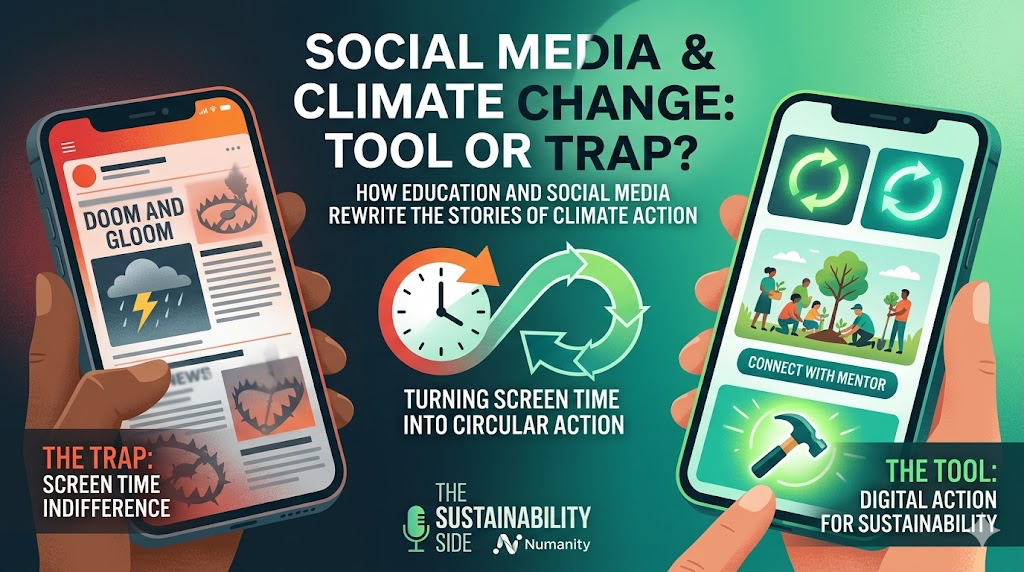
    1. The Hidden Crisis: Why Media Worsens “Doom and Gloom”

    When we think of climate news, we usually picture devastating statistics or catastrophic predictions. But Edwin points out a less visible impact: the toll on our mindset.

    The Pessimism Problem When environmental issues are portrayed strictly through a pessimistic lens, it creates a narrative that the world is doomed to burn by 2050. This leaves people feeling helpless rather than empowered to make a change.

    The Engagement Effect Driven by the rule that “what bleeds leads,” social media algorithms push content that evokes negative emotions because it garners more views and likes. This leads to:

    • Anxiety and Inaction: Users get riled up about problems without being offered realistic solutions.
    • Wasted Potential: The focus shifts to a marketing strategy for engagement rather than fostering genuine, actionable climate awareness.

    2. Turning the Tide: The Digital Education Model

    Edwin shared the inspiring vision behind his work with Numanity, an initiative aimed at the digital generation. Instead of viewing social media merely as a distraction, they are building a framework for accessible learning.

    The Digital Learning Hub By creating online communities outside of traditional, expensive university silos, this model serves three main purposes:

    • Accessible Knowledge: Breaking down financial and geographical barriers so anyone with a smartphone can learn about sustainability.
    • Digital Mentorship: Connecting young individuals directly with thought leaders and experts, providing streamlined guidance without needing to be in the same room.
    • Community Building: Fostering spaces where young people feel seen, supported, and motivated to create positive, tangible change together.

    This turns a daily scrolling habit into an empowerment tool that supports personal growth while protecting the environment.

    3. Movements & Participation: The “Hammer Model”

    Where does the digital world stand in the fight for sustainability? Edwin highlights a simple but profound analogy: social media is like a hammer.

    The secret? Intentional use. In this model, the technology itself is neutral. You can use a hammer to build things constructively, or you can use it to break things. The same goes for the devices in our hands.

    The Lesson for Us: While formal education lays a pathway for traditional careers, the grassroots reach of social media is what builds global movements. As Edwin says, “What dominates in the market is what value you can provide to people.” We have the power to curate our digital tools for impact rather than isolation.

    4. Your Action Plan: How to be “Digitally Empowered”

    Whether you are an aspiring eco-entrepreneur or just want to manage your screen time better, Edwin suggests starting small:

    • Curate Your Feed: Follow impactful accounts (like Impact and Environment) that focus on informative, solution-based content rather than doom and gloom.
    • Find Your Community: Don’t be afraid to connect with others who share your passions. Use platforms like LinkedIn to discover impactful job opportunities, workshops, and mentorship.
    • Mindset Shift: Stop seeing social media just as an entertainment trap. See it as a resource and a tool for your own benefit, allowing you to multiply your positive impact on the world.

    Conclusion: Reimagining Social Media as a Resource

    Digital immersion doesn’t just have to be about mindless scrolling. It can be about building back smarter networks. By integrating intentionality into our online habits, we turn a digital trap into a catalyst for new skills, wider awareness, and more resilient communities.

    Every action counts. Whether it’s sharing an informative post, finding a mentor online, or advocating for better environmental education, you are helping build a sustainable future.


    Ready to dive deeper into the intersection of technology and climate action? Support The Sustainability Side on Patreon and Ko-fi to access exclusive bonus episodes, deep dive toolkits, and behind-the-scenes content from our creators.

    Check out the episode on YouTube: Click here

    Connect with Edwin Siuda: You can find his work through Numanity (numanity.us) or follow their journey on Instagram (@numanityorg) and LinkedIn to see how digital education is transforming sustainability.

  • Unlocking the Hidden Goldmine: Why the Circular Economy is the Ultimate SME Superpower
    By Dr. Sama A | The Sustainability Side, Episode 4 Recap

    If you are running a small or medium-sized enterprise (SME), I want you to take a moment and think about your back room.

    You know that pile of offcuts you have been meaning to do something with? That equipment you replaced but haven’t sold? Those customer returns sitting in storage?

    What if I told you that stuff isn’t just clutter, it is potentially worth thousands of dollars in additional revenue?

    In this episode of The Sustainability Side, we move away from lofty academic theories and dive into practical, profitable strategies designed specifically for you—the small business owner. We were joined by the incredible Karen Formosa, a leading circular economy advocate and the force behind Practical Sustainability in the UK. Karen specializes in helping SMEs unlock the power of circular thinking without needing massive budgets or huge teams.

    Here is how you can stop running in circles and start thinking in them.

    1. The Mindset Shift: Flipping the Model

    To understand the opportunity, we first have to understand the flaw in how we currently do business.

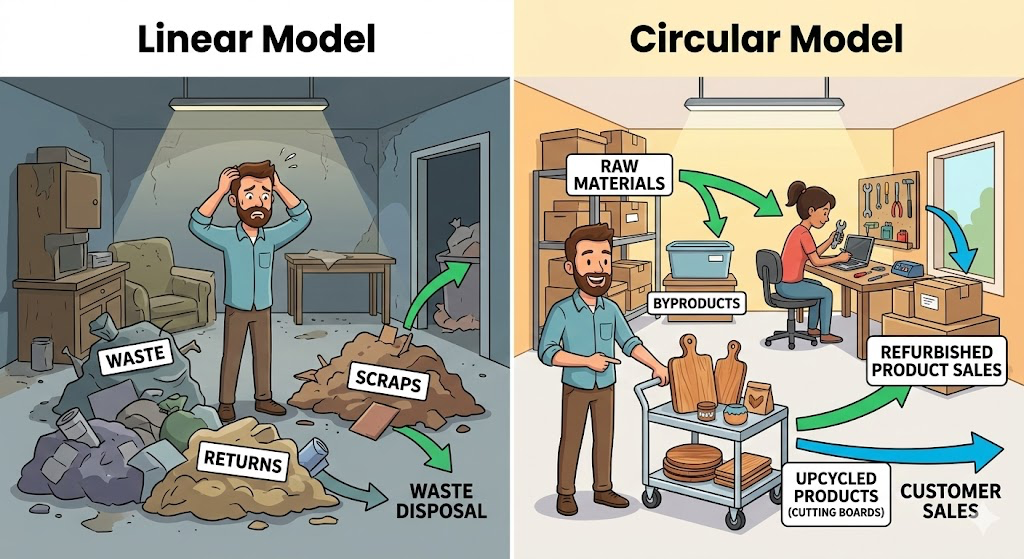
    The Linear Economy (Take-Make-Waste)

    Traditionally, business follows a straight line. We take resources from the earth, make products, use them, and then dispose of them as waste. This model assumes infinite resources and infinite waste capacity—neither of which exists in the real world.

    The Circular Economy (The Continuous Loop)

    The circular economy flips this on its head. Imagine a circle where resources flow in continuous loops. Waste from one process becomes input for another. Products are designed to be repaired, reused, or remanufactured. Nothing truly gets thrown away.

    Why this matters to you: In a linear model, you have one chance to make money (the sale). In a circular model, every point in that circle represents a potential new revenue stream.

    2. A Concrete Example: The Furniture Maker

    Karen shared a fascinating case study of a small furniture maker that perfectly illustrates the difference between thinking linearly and thinking circularly.

    • The Traditional Approach: A small business buys wood, makes tables, and sells them. When the customer leaves the shop, the relationship is over. When the table breaks, it goes to the landfill. This is one revenue stream.
    • The Circular Approach: This same manufacturer thinks deeper:
      1. Design for Repair: Tables are built to be easily fixed if damaged.
      2. Revenue Stream #2 (Maintenance): They offer an annual maintenance service. The customer pays for ongoing care, creating a “lifetime relationship.”
      3. Revenue Stream #3 (Buy-Back): When the customer is done, the business buys the table back, refurbishes it, and resells it.
      4. Revenue Stream #4 (Upcycling Waste): Wood scraps are turned into cutting boards or smaller decor items.
      5. Revenue Stream #5 (Selling By-products): Sawdust is bagged and sold to local gardeners.

    By changing their mindset, this SME turned one table into five distinct avenues for profit.

    3. The SME Advantage: Agility over Scale

    Many owners fear sustainability is too expensive. Karen addressed this head-on: SMEs have distinct advantages over Fortune 500 companies.

    Unlike large corporations bound by red tape, you have agility. You can pivot, test, and implement changes faster than any multinational giant. You know your customers personally, allowing you to build local partnerships that create mutual value.

    Three Core Principles for Success:

    • Design out waste: Plan for the product’s end-of-life from Day One.
    • Keep products and materials in use longer: Focus on services that extend life rather than just the one-time sale.
    • Regenerate natural systems: Move from “doing less harm” to “doing more good” for your local community.

    4. Your Road Map: How to Start This Week

    You don’t need perfection to start; you just need momentum.

    • Step 1: The Waste Audit: Track what your business throws away or pays to dispose of. Just note it down on a pad of paper.
    • Step 2: The Assessment: Look at that waste list. Is that waste an input for someone else? Can it be upcycled?
    • Step 3: Test One Idea: By the second week, identify just one idea worth testing. Start small, be transparent with your customers, and use their feedback to improve.

    Conclusion: A Smart Business Strategy

    The circular economy isn’t just an environmental movement; it is a smart business strategy to cut costs and boost profits.

    • Every piece of waste is money you’ve already spent.
    • Every transaction is the start of a long-term relationship.
    • Every resource challenge is a partnership opportunity.

    Don’t just watch from the sidelines—join us on the sustainability side.

    Want more actionable strategies? Support The Sustainability Side on Patreon or Coffee to access exclusive bonus episodes and deep-dive toolkits.

    Connect with Karen Formosa: Check out her channel, Practical Sustainability , or reach out to her on LinkedIn for a customized plan to take your business circular.