Tag: green-economy

  • Social Media & Climate Change: Tool or Trap? Turning Screen Time into Circular Action
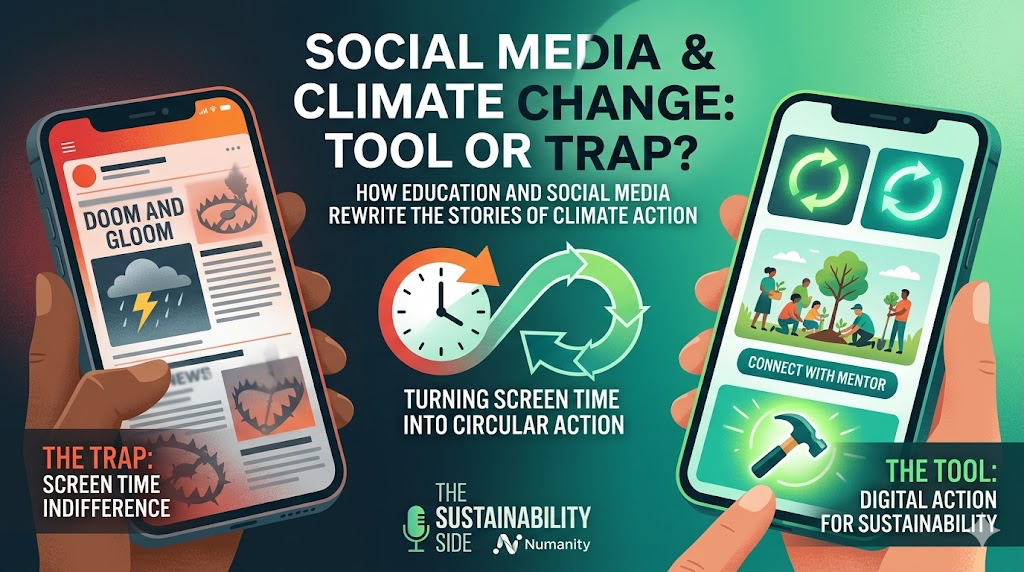
    Host: Dr. Sama A, Guest: Edwin Siuda | The Sustainability Side, Episode 8 Recap

    Every day, the world spends countless hours scrolling, with over 4.6 billion people using social media. That’s nearly 60% of the global population. But imagine what happens when we shift our digital habits.

    Suddenly, that massive amount of screen time becomes an opportunity for global change. Instead of falling into the trap of negativity and wasted time, vulnerable communities and younger generations can turn awareness into tangible action.

    In this episode of The Sustainability Side, we tackle a powerful question: How can two powerful forces—education and social media—rewrite the stories of climate action?

    We were joined by Edwin Siuda, co-founder of Numanity and a passionate voice for accessible environmental education. His work bridges the gap between digital immersion and community-driven sustainability.

    1. The Hidden Crisis: Why Media Worsens “Doom and Gloom”

    When we think of climate news, we usually picture devastating statistics or catastrophic predictions. But Edwin points out a less visible impact: the toll on our mindset.

    The Pessimism Problem When environmental issues are portrayed strictly through a pessimistic lens, it creates a narrative that the world is doomed to burn by 2050. This leaves people feeling helpless rather than empowered to make a change.

    The Engagement Effect Driven by the rule that “what bleeds leads,” social media algorithms push content that evokes negative emotions because it garners more views and likes. This leads to:

    • Anxiety and Inaction: Users get riled up about problems without being offered realistic solutions.
    • Wasted Potential: The focus shifts to a marketing strategy for engagement rather than fostering genuine, actionable climate awareness.

    2. Turning the Tide: The Digital Education Model

    Edwin shared the inspiring vision behind his work with Numanity, an initiative aimed at the digital generation. Instead of viewing social media merely as a distraction, they are building a framework for accessible learning.

    The Digital Learning Hub By creating online communities outside of traditional, expensive university silos, this model serves three main purposes:

    • Accessible Knowledge: Breaking down financial and geographical barriers so anyone with a smartphone can learn about sustainability.
    • Digital Mentorship: Connecting young individuals directly with thought leaders and experts, providing streamlined guidance without needing to be in the same room.
    • Community Building: Fostering spaces where young people feel seen, supported, and motivated to create positive, tangible change together.

    This turns a daily scrolling habit into an empowerment tool that supports personal growth while protecting the environment.

    3. Movements & Participation: The “Hammer Model”

    Where does the digital world stand in the fight for sustainability? Edwin highlights a simple but profound analogy: social media is like a hammer.

    The secret? Intentional use. In this model, the technology itself is neutral. You can use a hammer to build things constructively, or you can use it to break things. The same goes for the devices in our hands.

    The Lesson for Us: While formal education lays a pathway for traditional careers, the grassroots reach of social media is what builds global movements. As Edwin says, “What dominates in the market is what value you can provide to people.” We have the power to curate our digital tools for impact rather than isolation.

    4. Your Action Plan: How to be “Digitally Empowered”

    Whether you are an aspiring eco-entrepreneur or just want to manage your screen time better, Edwin suggests starting small:

    • Curate Your Feed: Follow impactful accounts (like Impact and Environment) that focus on informative, solution-based content rather than doom and gloom.
    • Find Your Community: Don’t be afraid to connect with others who share your passions. Use platforms like LinkedIn to discover impactful job opportunities, workshops, and mentorship.
    • Mindset Shift: Stop seeing social media just as an entertainment trap. See it as a resource and a tool for your own benefit, allowing you to multiply your positive impact on the world.

    Conclusion: Reimagining Social Media as a Resource

    Digital immersion doesn’t just have to be about mindless scrolling. It can be about building back smarter networks. By integrating intentionality into our online habits, we turn a digital trap into a catalyst for new skills, wider awareness, and more resilient communities.

    Every action counts. Whether it’s sharing an informative post, finding a mentor online, or advocating for better environmental education, you are helping build a sustainable future.


    Ready to dive deeper into the intersection of technology and climate action? Support The Sustainability Side on Patreon and Ko-fi to access exclusive bonus episodes, deep dive toolkits, and behind-the-scenes content from our creators.

    Check out the episode on YouTube: Click here

    Connect with Edwin Siuda: You can find his work through Numanity (numanity.us) or follow their journey on Instagram (@numanityorg) and LinkedIn to see how digital education is transforming sustainability.

  • Circular Practices: Building Resilient Economies for the Future
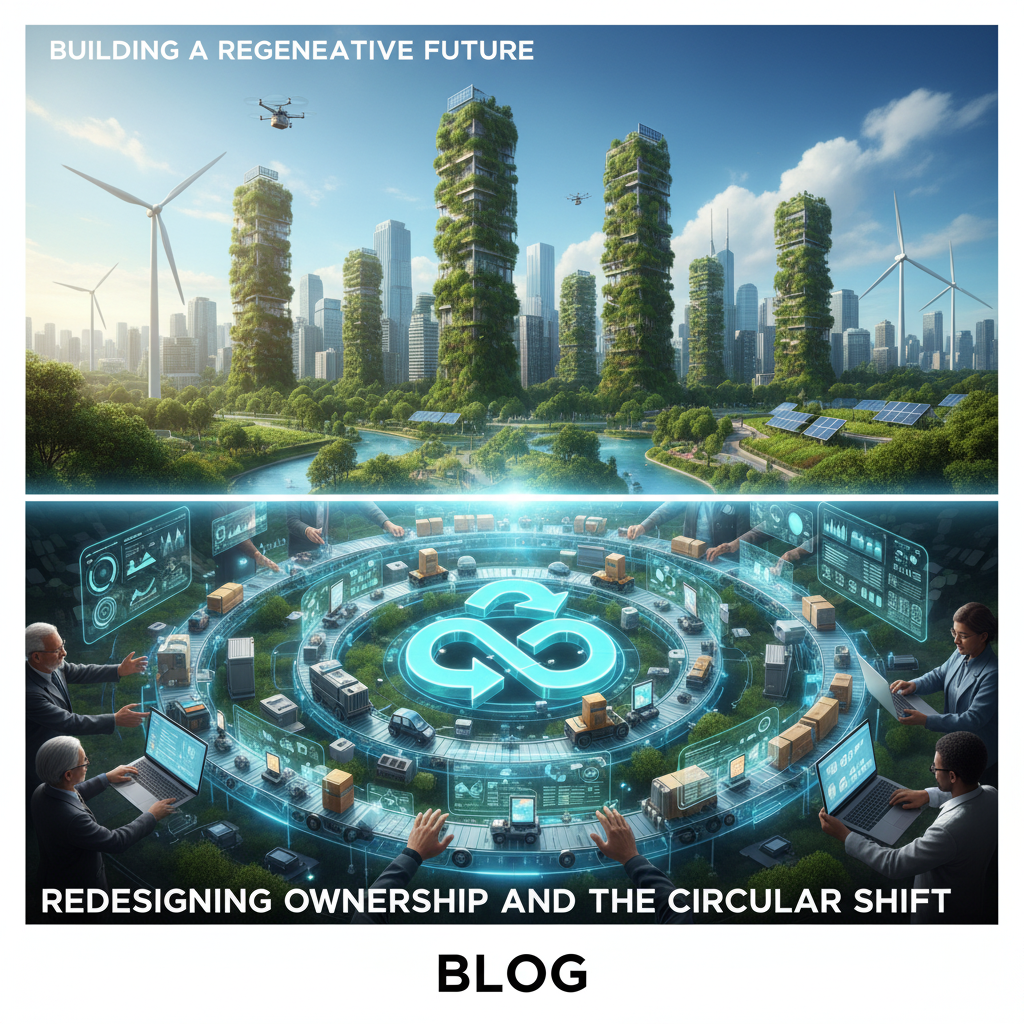
    Introduction: From Linear Waste to Regenerative Systems

    The world has long relied on a linear economy: extract, use, discard. This approach drives waste, pollution, and resource scarcity. Despite decades of recycling campaigns, less than 10% of plastics and textiles are truly recycled, and waste generation continues to soar.

    But there’s hope. The circular economy flips the linear model, emphasizing design for longevity, product reuse, and regeneration of natural systems. By rethinking ownership and shifting industrial systems, circular solutions create resilient economies, sustainable industries, and empowered consumers.

    This blog merges insights from two deep-dive episodes—Redesigning Ownership: How Circular Thinking Is Reshaping Our Lives and The Circular Shift: From Linear Waste to Regenerative Systems—to provide a comprehensive view of the circular future.


    1. Redefining Ownership: From Products to Services

    Products-as-a-Service (PaaS): The Ownership Revolution
    Ownership is evolving. Today, companies are offering functionality instead of products.

    • Rolls-Royce: Airlines pay for engine flight hours rather than engines themselves.
    • Homie (Middle East): Appliances are leased with delivery, maintenance, and replacement included.
    • India: Startups like Rentomojo lease furniture, electronics, and appliances, optimizing product lifespan and reducing waste.

    This model aligns business incentives with sustainability, as companies profit from durability, repairability, and resource efficiency.

    Modular Design: Upgrade, Don’t Replace
    Electronics and furniture are embracing modular, repairable designs:

    • Framework laptops allow upgrades and repairs without full replacement.
    • Fairphone extends smartphone lifespans to a decade.
    • iQube (India) develops modular furniture that adapts to changing needs.

    This approach reduces e-waste, CO2 emissions, and promotes a mindset shift from disposability to durability.


    2. The Circular Shift in Industries

    Fashion: Rental, Upcycling, and Biofabrication
    The fashion industry produces 100 billion garments annually. Circular innovations include:

    • Rent the Runway (USA): Closet-as-a-service rental models.
    • Stella McCartney & Hermès: Mushroom leather reduces water use by 95% and is biodegradable.
    • Doodlage & EcoRight (India): Convert pre-consumer textile waste into functional products.

    By extending product life and using alternative materials, circular fashion reduces emissions, resource use, and landfill pressure.

    Electronics: Remanufacturing and Printing-as-a-Service
    Electronic waste is growing fastest globally, projected at 82 million tons by 2030. Innovations include:

    • HP: Printing-as-a-Service model, charging per page, ensuring recycling and maintenance.
    • EU Right to Repair: Extended warranties and repair access incentivize durable design.
    • Middle East: Dubai-based tech hubs are piloting e-waste refurbishment programs.

    Food Systems: Closing the Loop
    Globally, 1.3 billion tons of food are wasted annually. Circular innovations transform waste into value:

    • Singapore Tuas Nexus: Anaerobic digestion converts food waste into biogas, fertilizer, and clean water.
    • Phool.co (India): Floral waste is upcycled into incense and packaging.
    • Masdar City (UAE): Organic waste becomes energy and compost, supporting urban sustainability.

    Circular food systems reduce greenhouse gas emissions, support regenerative agriculture, and create local economic opportunities.


    3. Consumer, Professional, and Policy Roles

    Consumers: Every Purchase is a Vote
    Your buying choices send signals. Opting for repairable, modular, or service-based products encourages sustainable markets.

    Professionals & Businesses:
    Advocate for circular practices—take-back programs, modular design, service-based models—and integrate sustainability into corporate strategies.

    Policy & Infrastructure:
    Systemic change requires Extended Producer Responsibility, carbon pricing, and infrastructure for collection, remanufacturing, and sharing services.

    Network effects amplify impact: every conscious choice encourages businesses, policymakers, and communities to adopt circular practices.


    4. Economic and Environmental Benefits

    • Circular industries grow faster than linear competitors (3.1% higher annual growth).
    • Companies embracing circular models see 15-20% revenue growth and 10-15% cost savings.
    • Global circular economy market projected to exceed $700 billion by 2026.
    • Circular practices reduce CO2 emissions, waste, and dependence on virgin materials.

    By combining smart business models, consumer action, and supportive policies, the circular economy is not just sustainable, it’s profitable and resilient.


    Conclusion: A Regenerative Future is Within Reach

    The circular economy challenges the status quo:

    • Move from ownership to access.
    • Redesign products for longevity.
    • Transform waste into valuable resources.
    • Support policy frameworks and infrastructures for systemic change.

    The result? A regenerative economy that works with nature, not against it—resilient, profitable, and equitable.

    By adopting circular principles in daily life, industry, and governance, we can transition from linear waste systems to thriving, sustainable systems.