Tag: recycling

  • Unlocking the Hidden Goldmine: Why the Circular Economy is the Ultimate SME Superpower
    By Dr. Sama A | The Sustainability Side, Episode 4 Recap

    If you are running a small or medium-sized enterprise (SME), I want you to take a moment and think about your back room.

    You know that pile of offcuts you have been meaning to do something with? That equipment you replaced but haven’t sold? Those customer returns sitting in storage?

    What if I told you that stuff isn’t just clutter, it is potentially worth thousands of dollars in additional revenue?

    In this episode of The Sustainability Side, we move away from lofty academic theories and dive into practical, profitable strategies designed specifically for you—the small business owner. We were joined by the incredible Karen Formosa, a leading circular economy advocate and the force behind Practical Sustainability in the UK. Karen specializes in helping SMEs unlock the power of circular thinking without needing massive budgets or huge teams.

    Here is how you can stop running in circles and start thinking in them.

    1. The Mindset Shift: Flipping the Model

    To understand the opportunity, we first have to understand the flaw in how we currently do business.

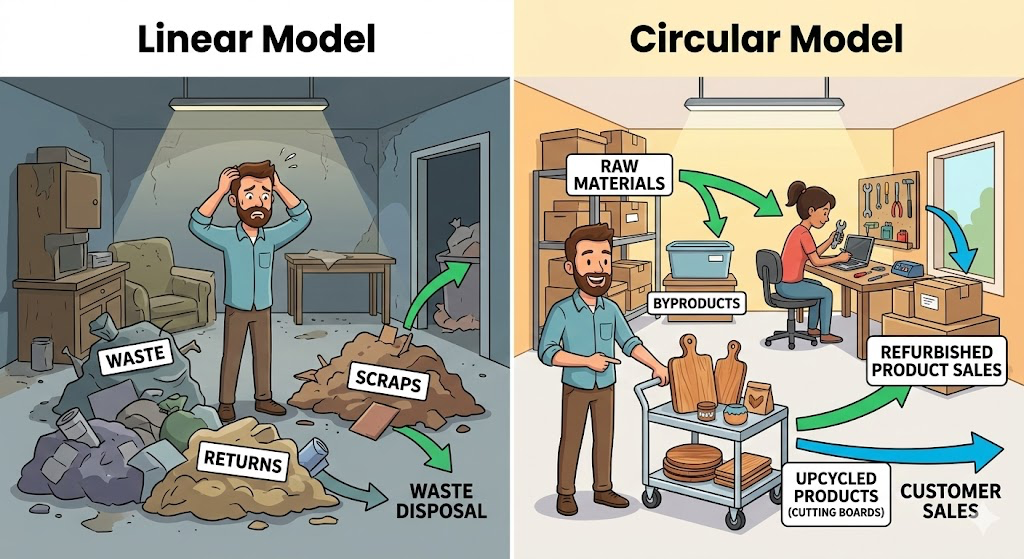
    The Linear Economy (Take-Make-Waste)

    Traditionally, business follows a straight line. We take resources from the earth, make products, use them, and then dispose of them as waste. This model assumes infinite resources and infinite waste capacity—neither of which exists in the real world.

    The Circular Economy (The Continuous Loop)

    The circular economy flips this on its head. Imagine a circle where resources flow in continuous loops. Waste from one process becomes input for another. Products are designed to be repaired, reused, or remanufactured. Nothing truly gets thrown away.

    Why this matters to you: In a linear model, you have one chance to make money (the sale). In a circular model, every point in that circle represents a potential new revenue stream.

    2. A Concrete Example: The Furniture Maker

    Karen shared a fascinating case study of a small furniture maker that perfectly illustrates the difference between thinking linearly and thinking circularly.

    • The Traditional Approach: A small business buys wood, makes tables, and sells them. When the customer leaves the shop, the relationship is over. When the table breaks, it goes to the landfill. This is one revenue stream.
    • The Circular Approach: This same manufacturer thinks deeper:
      1. Design for Repair: Tables are built to be easily fixed if damaged.
      2. Revenue Stream #2 (Maintenance): They offer an annual maintenance service. The customer pays for ongoing care, creating a “lifetime relationship.”
      3. Revenue Stream #3 (Buy-Back): When the customer is done, the business buys the table back, refurbishes it, and resells it.
      4. Revenue Stream #4 (Upcycling Waste): Wood scraps are turned into cutting boards or smaller decor items.
      5. Revenue Stream #5 (Selling By-products): Sawdust is bagged and sold to local gardeners.

    By changing their mindset, this SME turned one table into five distinct avenues for profit.

    3. The SME Advantage: Agility over Scale

    Many owners fear sustainability is too expensive. Karen addressed this head-on: SMEs have distinct advantages over Fortune 500 companies.

    Unlike large corporations bound by red tape, you have agility. You can pivot, test, and implement changes faster than any multinational giant. You know your customers personally, allowing you to build local partnerships that create mutual value.

    Three Core Principles for Success:

    • Design out waste: Plan for the product’s end-of-life from Day One.
    • Keep products and materials in use longer: Focus on services that extend life rather than just the one-time sale.
    • Regenerate natural systems: Move from “doing less harm” to “doing more good” for your local community.

    4. Your Road Map: How to Start This Week

    You don’t need perfection to start; you just need momentum.

    • Step 1: The Waste Audit: Track what your business throws away or pays to dispose of. Just note it down on a pad of paper.
    • Step 2: The Assessment: Look at that waste list. Is that waste an input for someone else? Can it be upcycled?
    • Step 3: Test One Idea: By the second week, identify just one idea worth testing. Start small, be transparent with your customers, and use their feedback to improve.

    Conclusion: A Smart Business Strategy

    The circular economy isn’t just an environmental movement; it is a smart business strategy to cut costs and boost profits.

    • Every piece of waste is money you’ve already spent.
    • Every transaction is the start of a long-term relationship.
    • Every resource challenge is a partnership opportunity.

    Don’t just watch from the sidelines—join us on the sustainability side.

    Want more actionable strategies? Support The Sustainability Side on Patreon or Coffee to access exclusive bonus episodes and deep-dive toolkits.

    Connect with Karen Formosa: Check out her channel, Practical Sustainability , or reach out to her on LinkedIn for a customized plan to take your business circular.

  • Circular Practices: Building Resilient Economies for the Future
    Introduction: From Linear Waste to Regenerative Systems

    The world has long relied on a linear economy: extract, use, discard. This approach drives waste, pollution, and resource scarcity. Despite decades of recycling campaigns, less than 10% of plastics and textiles are truly recycled, and waste generation continues to soar.

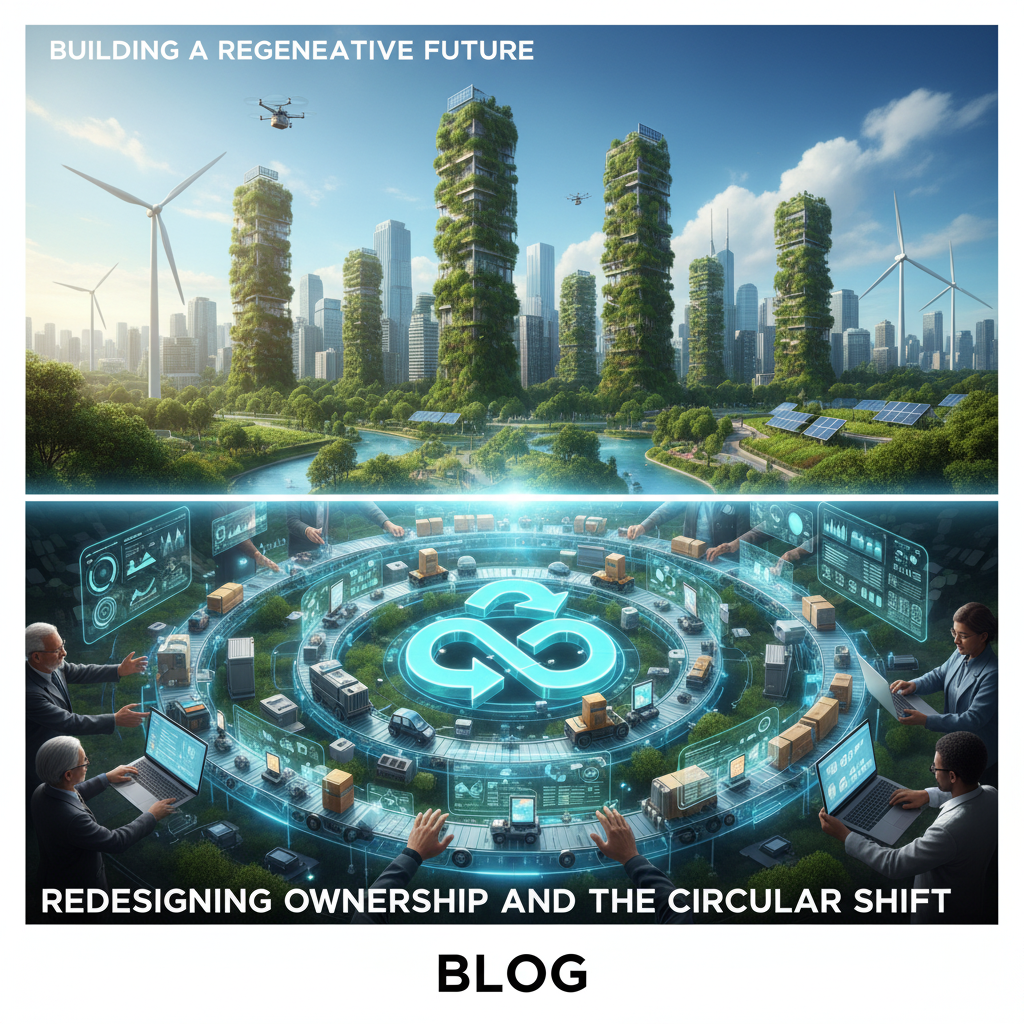
    But there’s hope. The circular economy flips the linear model, emphasizing design for longevity, product reuse, and regeneration of natural systems. By rethinking ownership and shifting industrial systems, circular solutions create resilient economies, sustainable industries, and empowered consumers.

    This blog merges insights from two deep-dive episodes—Redesigning Ownership: How Circular Thinking Is Reshaping Our Lives and The Circular Shift: From Linear Waste to Regenerative Systems—to provide a comprehensive view of the circular future.


    1. Redefining Ownership: From Products to Services

    Products-as-a-Service (PaaS): The Ownership Revolution
    Ownership is evolving. Today, companies are offering functionality instead of products.

    • Rolls-Royce: Airlines pay for engine flight hours rather than engines themselves.
    • Homie (Middle East): Appliances are leased with delivery, maintenance, and replacement included.
    • India: Startups like Rentomojo lease furniture, electronics, and appliances, optimizing product lifespan and reducing waste.

    This model aligns business incentives with sustainability, as companies profit from durability, repairability, and resource efficiency.

    Modular Design: Upgrade, Don’t Replace
    Electronics and furniture are embracing modular, repairable designs:

    • Framework laptops allow upgrades and repairs without full replacement.
    • Fairphone extends smartphone lifespans to a decade.
    • iQube (India) develops modular furniture that adapts to changing needs.

    This approach reduces e-waste, CO2 emissions, and promotes a mindset shift from disposability to durability.


    2. The Circular Shift in Industries

    Fashion: Rental, Upcycling, and Biofabrication
    The fashion industry produces 100 billion garments annually. Circular innovations include:

    • Rent the Runway (USA): Closet-as-a-service rental models.
    • Stella McCartney & Hermès: Mushroom leather reduces water use by 95% and is biodegradable.
    • Doodlage & EcoRight (India): Convert pre-consumer textile waste into functional products.

    By extending product life and using alternative materials, circular fashion reduces emissions, resource use, and landfill pressure.

    Electronics: Remanufacturing and Printing-as-a-Service
    Electronic waste is growing fastest globally, projected at 82 million tons by 2030. Innovations include:

    • HP: Printing-as-a-Service model, charging per page, ensuring recycling and maintenance.
    • EU Right to Repair: Extended warranties and repair access incentivize durable design.
    • Middle East: Dubai-based tech hubs are piloting e-waste refurbishment programs.

    Food Systems: Closing the Loop
    Globally, 1.3 billion tons of food are wasted annually. Circular innovations transform waste into value:

    • Singapore Tuas Nexus: Anaerobic digestion converts food waste into biogas, fertilizer, and clean water.
    • Phool.co (India): Floral waste is upcycled into incense and packaging.
    • Masdar City (UAE): Organic waste becomes energy and compost, supporting urban sustainability.

    Circular food systems reduce greenhouse gas emissions, support regenerative agriculture, and create local economic opportunities.


    3. Consumer, Professional, and Policy Roles

    Consumers: Every Purchase is a Vote
    Your buying choices send signals. Opting for repairable, modular, or service-based products encourages sustainable markets.

    Professionals & Businesses:
    Advocate for circular practices—take-back programs, modular design, service-based models—and integrate sustainability into corporate strategies.

    Policy & Infrastructure:
    Systemic change requires Extended Producer Responsibility, carbon pricing, and infrastructure for collection, remanufacturing, and sharing services.

    Network effects amplify impact: every conscious choice encourages businesses, policymakers, and communities to adopt circular practices.


    4. Economic and Environmental Benefits

    • Circular industries grow faster than linear competitors (3.1% higher annual growth).
    • Companies embracing circular models see 15-20% revenue growth and 10-15% cost savings.
    • Global circular economy market projected to exceed $700 billion by 2026.
    • Circular practices reduce CO2 emissions, waste, and dependence on virgin materials.

    By combining smart business models, consumer action, and supportive policies, the circular economy is not just sustainable, it’s profitable and resilient.


    Conclusion: A Regenerative Future is Within Reach

    The circular economy challenges the status quo:

    • Move from ownership to access.
    • Redesign products for longevity.
    • Transform waste into valuable resources.
    • Support policy frameworks and infrastructures for systemic change.

    The result? A regenerative economy that works with nature, not against it—resilient, profitable, and equitable.

    By adopting circular principles in daily life, industry, and governance, we can transition from linear waste systems to thriving, sustainable systems.