Tag: nature

  • From Waste to Wealth: Navigating Nigeria’s Circular Food Frontier
    Host: Dr. Sama A, Guest: Iyanuoluwa Faith Abimbola | The Sustainability Side, Episode 10 Recap

    Every year, Nigeria generates over 32 million tons of solid waste. Nearly half of that is food waste, yet less than 10% is currently recycled. That is more than just a statistic; it is a staggering amount of “wasted potential” ending up in landfills and waterways.

    But what if we stopped seeing waste as a problem and started seeing it as a resource? On this episode of The Sustainability Side, we dive into the Circular Shift, a movement to re-imagine Nigerian food systems to reduce waste, regenerate ecosystems, and build a resilient future.

    We were joined by Iyanuoluwa Faith Abimbola, a fisheries scientist and sustainability enthusiast whose work bridges the gap between aquaculture health and eco friendly innovation.

    1. The Cultural Shift: It’s Not New, It’s Nigerian

    While “Circular Economy” sounds like a high-tech global trend, Faith points out that its principles have been part of the Nigerian daily life for generations.

    • The Traditional Roots: From handing down clothes to younger siblings to repurposing old fabrics as rags, the concept of a “total life cycle” is already built into our culture.
    • The Convenience Trap: The rise of plastic sachet water was born from a need for convenience. However, before the sachet, Nigerians relied on refillable pots and pails, a naturally circular system.
    • The Opportunity: Shifting back to sustainability doesn’t mean “dehydrating the poor”; it means businesses must innovate and ideate around refill stations and biodegradable alternatives that thrive in our climate.

    2. The 4 Untapped “Gold Mines” in Food Waste

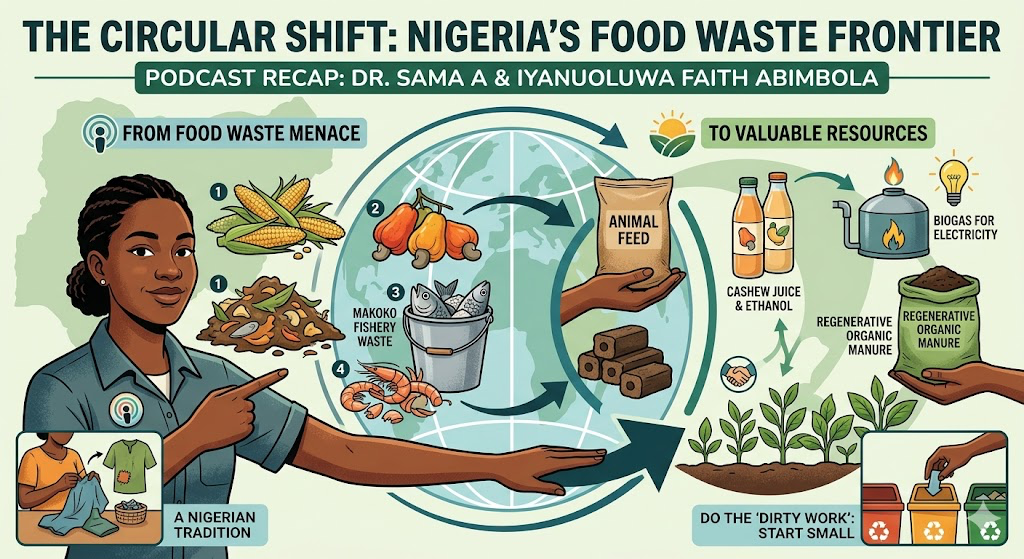
    Where others see trash, Faith sees a commercial treasure trove. She highlighted four specific waste streams that are currently undervalued in Nigeria:

    • Corn Cobs: Often discarded, these can be processed into animal feed or used to create fuel briquettes for energy.
    • Cashew Apples: While the nuts are exported, the apples are often left to rot, releasing methane. They can be transformed into juices or ethanol.
    • Fishery Waste: Fish scales and heads from markets like Makoko are perfect feed-stock for biogas plants to generate electricity.
    • Shrimp Shells: Rich in chitosan, these shells are a premium source for soil conditioners and regenerative organic manure.

    3. The Investor’s Reality Check: Do the “Dirty Work”

    If you are an aspiring eco-entrepreneur, Faith’s advice is grounded in the hard reality of the Nigerian market. Green investors aren’t just chasing elegant ideas; they are backing execution.

    • Access Over Apps: Investors care less about a fancy SAS platform and more about feed-stock access. If you can prove you have a signed agreement to collect 1,000 tons of waste, you are investable.
    • The “Dirty Job” Model: The real money is made in the downstream—the physical collection and processing. Technology should be a tool to make this “dirty work” seamless, not a replacement for it.
    • Unit Economics: A model that works profitably for 10 tons a week is far more attractive to a funder than a grand “scale-up” plan that hasn’t moved a single bag of waste yet.

    4. Your Action Plan: Starting with Zero Capital

    You don’t need a massive grant to join the circular movement. Faith suggests looking at the waste systems already in your backyard:

    • Identify the Stream: Visit local markets (like the grain or fish markets) where waste is currently a “menace” to the sellers. They will often give you the waste for free just to clear the space.
    • Focus on the “Small Win”: Start by collecting specific waste for existing biogas plants or organic farmers.
    • The Mindset Breakthrough: Stop waiting for the government to “do business.” The government’s role is to create an enabling environment; the individual’s role is to provide the value and the solution.

    Conclusion: Reimagining Sustainability as a Culture

    Sustainability in Nigeria isn’t just about protecting the planet; it’s about building smarter, more resilient communities. By turning our “waste” into “wealth,” we move toward a future where circularity isn’t just a choice—it’s our culture.

    Every step toward circularity, no matter how small, helps build a better way forward. As Faith prepares for her PhD journey in ocean management, her message remains: Sustainability is not just mine, it’s ours.

    Ready to dive deeper into the future of circular food systems? Support The Sustainability Side on PatreonKo-fi, or join our Discord community to access exclusive bonus content and connect with fellow change-makers.

    • Check out the episode on YouTube: Click here to watch
    • Connect with Iyanuoluwa Faith Abimbola: Follow her journey as she explores the intersections of fisheries, climate resilience, and circular food systems.