
Host: Dr. Sama A. | Guest: Mr. Manish Kothari | The Sustainability Side, Episode 9 Recap (Parts 1 & 2)
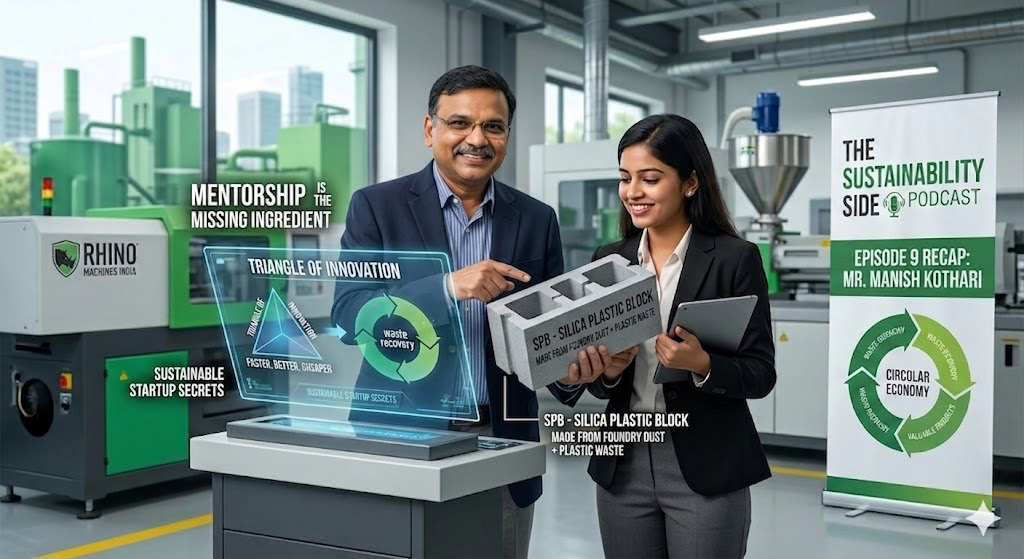
In India, 90% of startups fail. This isn’t just a number; it represents the “founder’s grave” where dreams stall before they can scale. However, there is a powerful antidote: mentored startups have a 70% survival rate. On this double-feature recap of The Sustainability Side, we explore why mentorship is the missing ingredient for success and how to build a business that thrives sustainably—not as a buzzword, but as an operational reality.
We were joined by Mr. Manish Kothari, Director and CEO of Rhino Machines. With a 33-year legacy of innovation, Manish has turned waste recovery into a science, famously developing the Silica Plastic Block (SPB) which transforms foundry dust and plastic waste into high-value building materials.
1. Mentorship vs. Advisory: The 95% Success Factor
The critical gap in today’s ecosystem is the confusion between “advice” and “mentorship”.
- Demonstration Over Theory: True mentorship is not about telling people what to do; it is about demonstration by a senior entrepreneur who is invested in the founder’s success.
- The Power of Resilience: Drawing from the EMPRETEC (Hira) program, Manish notes that attaching hungry entrepreneurs to senior mentors—focused on behavioral traits like resilience and competitiveness—can raise success rates from a meager 2% to over 95%.
- The Peer-to-Peer Shift: Even as a mentor, a leader must remain in “learning mode,” acknowledging that they don’t know everything and absorbing insights from younger generations.
2. The 4 Pillars of a Sustainable Business
Building a sustainable startup requires balancing four distinct pillars adapted from the UNCTAD business linkages framework:
- Technology: Solving the technical puzzle (e.g., creating an extruder that bonds sand and plastic efficiently).
- Market: Ensuring the product meets the “Triangle of Innovation”—it must be Faster, Better, and Cheaper than traditional alternatives.
- Culture: Cultivating an entrepreneurial mindset that understands risk-taking, goal setting, and clarity of direction.
- Finance: Viewing capital not as the starting point, but as an outcome of mastering the first three pillars.
3. Case Study: The Silica Plastic Block (SPB)
Where the foundry industry saw a “dust menace,” Manish saw a “gold mine”.
- Stitching the Ecosystem: Success didn’t come from going solo. Rhino Machines collaborated with research partners, hospitals for plastic waste collection, and local community clubs to ensure a consistent supply chain.
- Breaking the “Sustainability Premium”: Many perceive eco-friendly products as expensive. To counter this, Manish moved beyond the standard brick to create interlocking, hollow Lego-style blocks.
- Cost Competitiveness: Because these blocks require zero cement mortar for bonding, the total construction cost is actually cheaper than using traditional red clay bricks.
4. Turning Critical Feedback into Innovation
New innovations often face skepticism regarding microplastics, fire safety, or leaching.
- Respond, Don’t React: Manish advocates for “governing your emotions” and treating criticism as critical feedback.
- Collaborative Problem Solving: When questioned about microplastics, his response is an invitation: “Give me a way to test it, and we will work together to find the solution”.
- Bridging the Academic Gap: He highlights the need for academic institutions to move faster and be more open to collaborating with MSMEs on credible testing for new materials.
Action Plan: Moving from Syllabus to Reality
For the “younger founders in the trenches,” Manish offers three final pieces of wisdom:
- Existentialism Over Essentialism: Stop focusing only on the “syllabus” (what should happen) and start studying what exists today.
- Make Internships Accountable: If you lead a team, don’t just tell them to “watch.” Give interns specific, measurable projects that force them to use their brains and ask questions.
- The Rising Tide: Shift from “I, Me, Myself” to an ecosystem mindset. When you invest in your community’s success, your own business sustains itself naturally.
Conclusion: Sustainability is Not a Solo Sport As Manish Kothari reminds us, “The rising tides will lift all the boats”. Whether you are a student, a founder, or a policymaker, the path forward is built on shared purpose and partnership.
Ready to learn how the future of building is becoming more intelligent?
- Watch the Full Episode (Part 1): Click here
- Watch the Strategic Growth Deep Dive (Part 2): Click here
- Support the Mission: Join our community on Patreon or Ko-fi to access exclusive toolkits and behind-the-scenes content that helps you put sustainability into action.
Connect with Mr. Manish Kothari: Follow Rhino Machines and explore the Hira Program to see how circular economy principles are transforming Indian manufacturing.

Leave a Reply