Host: Dr. Sama A. | Guest: Dr. V. Murugesh | The Sustainability Side, Episode 18 Recap
Every day, industries across the globe generate millions of tons of pollutants—hazardous materials that we traditionally scramble to hide, bury, or legally dispose of. But what if our biggest environmental burdens are actually the raw building blocks of tomorrow’s cities?
In this episode of The Sustainability Side, we explore why sustainable infrastructure is a highly calculated engineering discipline that turns structural liabilities into high-performance assets—transforming waste from a public menace into a massive economic opportunity.
We were joined by Dr. V. Murugesh, Professor and Head of the JCT College of Engineering and Technology. An expert in sustainable materials, Dr. Murugesh is bridging the gap between rigorous laboratory research and real-world infrastructure applications to push the boundaries of green engineering.
1. The Valorization Equation: Engineering Over Trend
A critical mistake in the sustainability conversation is treating it like a design trend or cosmetic choice. True sustainable construction relies on a strict engineering framework called the Valorization Equation.
- The Core Formula: It takes a raw pollutant, subjects it to systematic engineering intervention—whether mechanical, chemical, or thermal decomposition—and yields an entirely new structural product.
- Targeting the Footprint: Conventional manufacturing automatically triggers an initial 15% to 17% of embodied carbon during raw extraction and transport. The remaining 83% to 85% represents operational carbon emitted over the building’s 40-to-50-year lifecycle.
- The Carbon Capture Shift: Rather than allowing building materials to emit greenhouse gases, engineering a product with high carbon-sequestration potential allows the building itself to capture and lock away carbon permanently.
2. From Liabilities to Building Blocks: Key Material Substitutions
Dr. Murugesh broke down how specific industrial and agricultural waste streams can completely displace resource-heavy conventional materials:
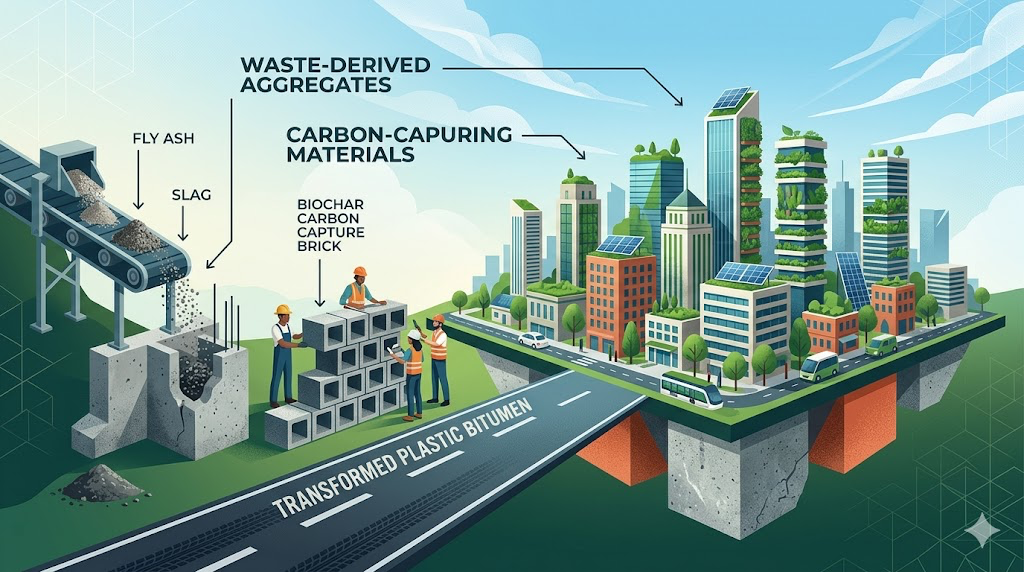
- Industrial Byproducts: Materials like Fly Ash (from thermal power plants) and GGBS (Ground Granulated Blast-Furnace Slag from steel plants) serve as phenomenal cementitious replacements. Utilizing geopolymer concrete mixes dramatically reduces the embodied carbon of foundations.
- Agricultural Residues: Rice husk ash and biochar offer incredible carbon-capturing potential, eliminating synthetic insulating variants while improving natural performance.
- Plastic & Secondary Markets: Waste plastics act as highly durable bitumen modifiers for laying down roads, while industrial foundry sand can safely substitute up to 40% of traditional construction sand.
3. Case Study: The Carbon Capture Biochar Brick
The biggest hurdle for eco-friendly concrete isn’t the science; it’s changing the builder’s mindset. To answer the inevitable industry questions about cost and durability, Dr. Murugesh shared a powerful real-world case study developed at JCT College: The Biochar Carbon Capture Brick.
When stacked up against traditional clay bricks, the engineering metrics tell a clear story:
- Superior Strength: Traditional bricks carry a crushing strength of about 7.5 $N/mm^2$. The biochar-infused brick reaches 10.75 $N/mm^2$.
- Lower Water Absorption: Permissible water absorption limits for standard bricks sit around 5% to 6%. The biochar brick drops down to 2% to 3% because the biochar micro-fillers perfectly pack the structural pores, blocking moisture ingress.
- The Financial Advantage: While a traditional brick costs roughly ₹9.00, the carbon capture brick costs just ₹6.50—cutting material costs by nearly 27% by turning zero-value waste into structural wealth.
4. Overcoming the Scaling Bottlenecks in India
Transitioning to a fully circular built environment requires moving past grassroots experiments and addressing three systemic macroeconomic realities:
- The Code Book Vacuum: The primary reason civil engineers and structural consultants reject sustainable materials is a lack of updated national standard code books (like specific Indian Standards or ISO guidelines) for alternative blends.
- Validation and Frameworks: To generate true market demand, sustainable products must seek standard validation through recognized global green building frameworks like LEED, BREEAM, and QS.
- Linear vs. Circular Design: The modern construction market is stuck in a “Take-Make-Dispose” model. True circularity requires modular engineering—building structures with panels that can be easily unbolted, dismantled, and recycled at their end-of-life rather than dumped into a landfill.
Action Plan: Moving from Theory to Structural Impact
For engineers, students, and green developers standing in the field today, Dr. Murugesh highlights three pathways for real-world impact:
- Systematic Analysis: Never sacrifice strength and durability for an eco-friendly label; track and prove the engineering metrics first.
- Push for Standardization: Collaborate with academic institutions and testing laboratories to secure credible certifications that give commercial buyers confidence.
- Ecosystem-Driven Supply: Build partnerships between the industries producing the waste (thermal plants, steel factories, agricultural networks) and the construction firms consuming them to ensure a consistent material pipeline.
Conclusion: Redefining the Way We Build As Dr. Murugesh reminds us, reducing our environmental impact is not a passive design choice; it is an active, systematic engineering process. Turning pollution into potential isn’t just an idea—it is an economic opportunity and a shared responsibility.
Ready to see the frameworks, slides, and deep-dive technical data behind these innovations?
- Watch the Full Episode: Click here
- Explore More Recaps: Follow The Sustainability Side across your favorite streaming platforms to catch the latest episodes.
- Support the Mission: Join our community to access exclusive toolkits, research resources, and behind-the-scenes content that helps you turn conversation into measurable impact.
Connect with Dr. V. Murugesh: Reach out via JCT College of Engineering and Technology to learn more about eco-concrete testing, material validation parameters, and green structural alternatives.

Leave a Reply